Field Armour
around 1450. Gauntlets: around 1475/1485. | Kurfürst Friedrich I. Sohn des Ludwig III. von der Pfalz
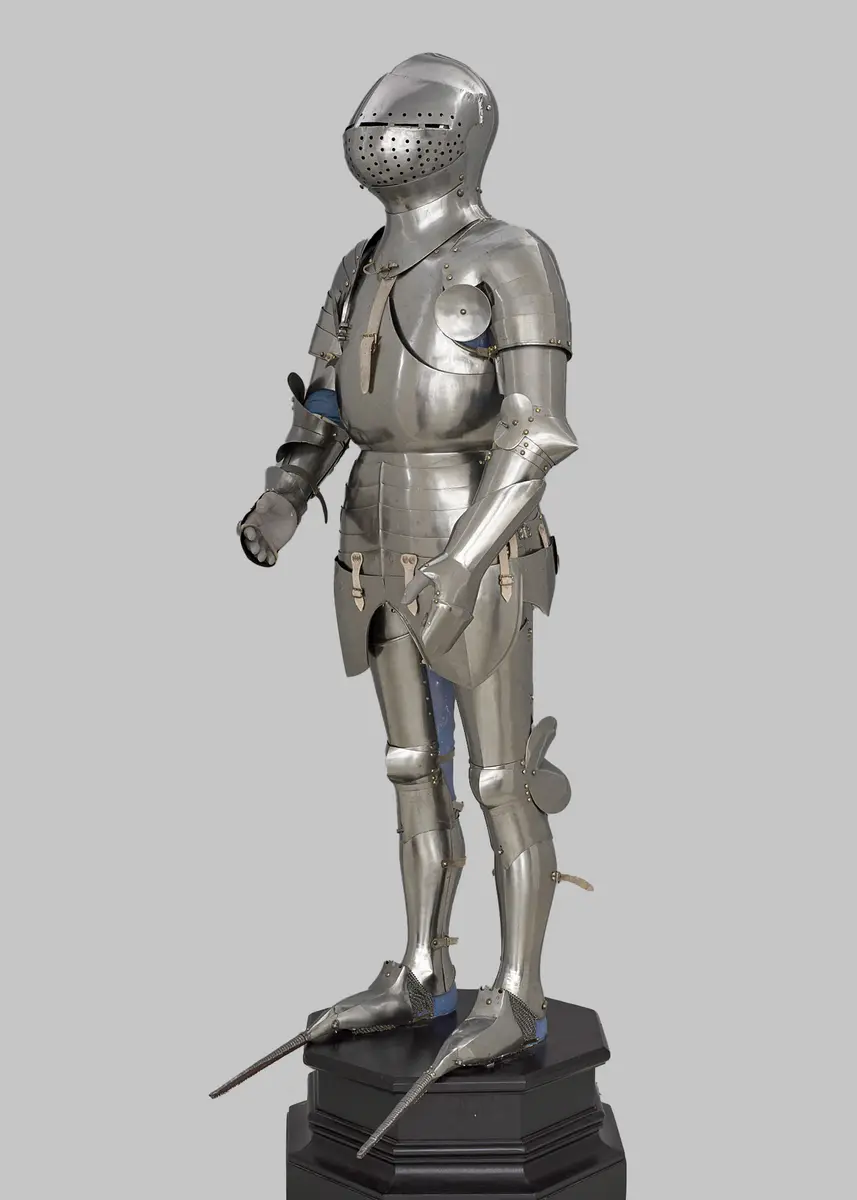
This armour is eloquent of the skill of Milanese fifteenth-century armourers. Commissioned around 1450 by Frederick I, Elector of the Palatine, it was produced by Tomaso Missaglia in collaboration with several other masters. In addition to Tommaso’s workshop mark and master’s mark, the armour was stamped with the marks of three other master-craftsmen – Antonio Missaglia, Innocenzo da Faerno, and Antonio Seroni. Such a division of labour was typical of Milan, then one of the leading centres of armour production in Europe. As armourers specialized in different parts of the harness – helmets, gauntlets, greaves, etc. – it was more efficient for them to collaborate. The homogenous appearance of this armour bears witness to the professionalism of the collaborating master-craftsmen.
Stylistically, we can date this armour to the mid-fifteenth century. Frederick presumably commissioned it for his accession in 1449. The marks of blows on the helmet show that he wore it in battle. However, some of the details of this harness do not conform to what one would expect of typical coeval Italian armour. For instance, the helmet is a grand basinet, a voluminous helmet with circular visor then popular in France but not in Italy. The shoulders are symmetrical and have besagews to protect the armpits. In ‘regular’ Italian armour, the right shoulder is smaller than the left, affording the wearer’s right arm (which wields the sword) additional mobility.
The armour includes stirrups that end in long tapered points, imitating the then fashionable poulaines popular mainly north of the Alps. This means the harness is export armour alla francese (in the French style), produced by Milanese armourers according to the requirements and tastes of their foreign client. They also produced armour in the German style (alla tedesca).
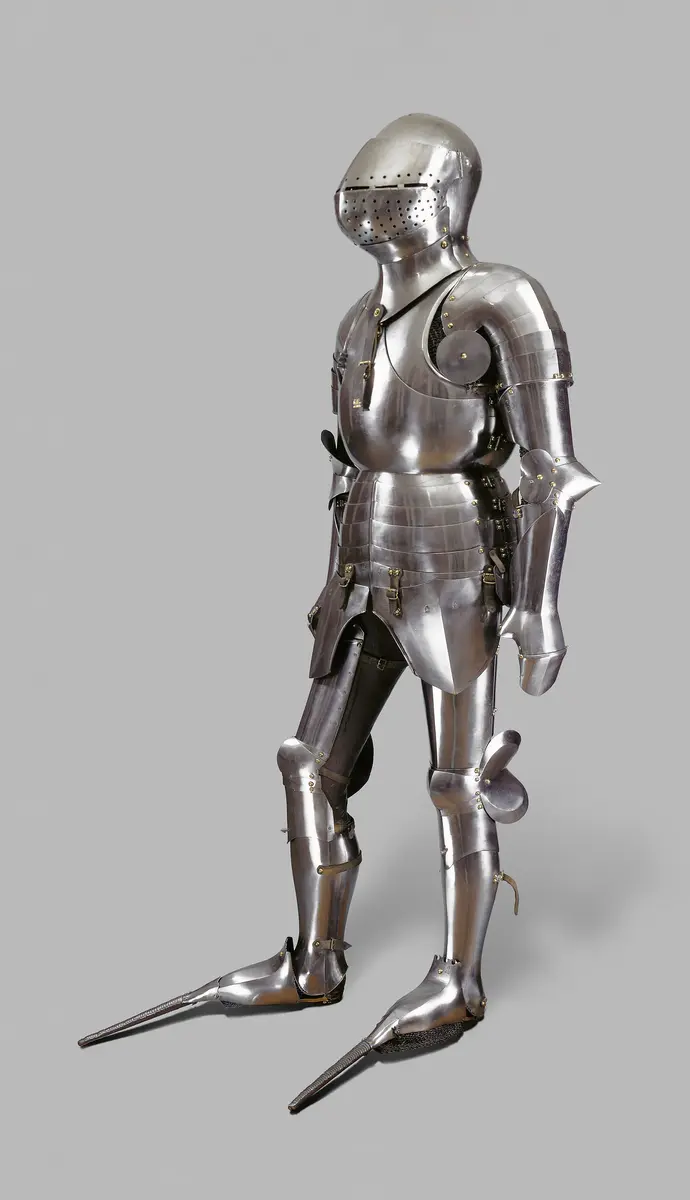
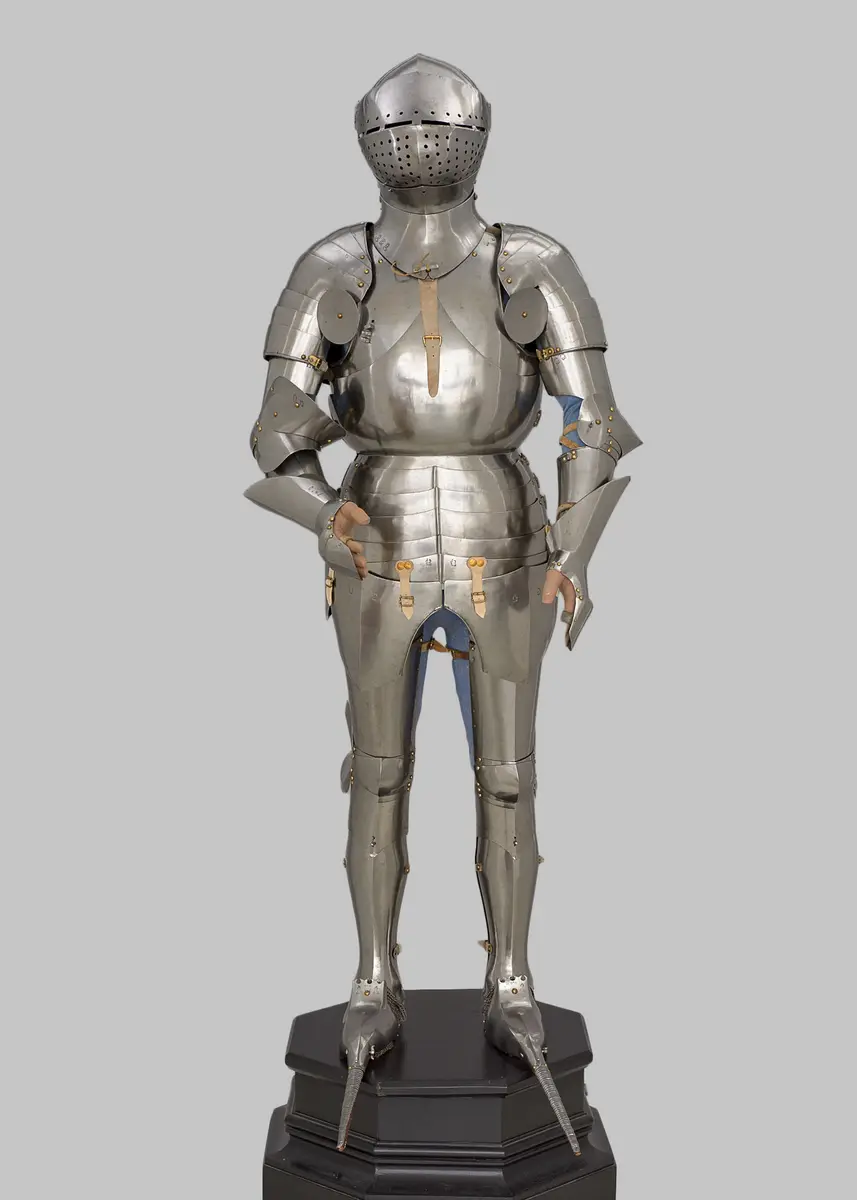
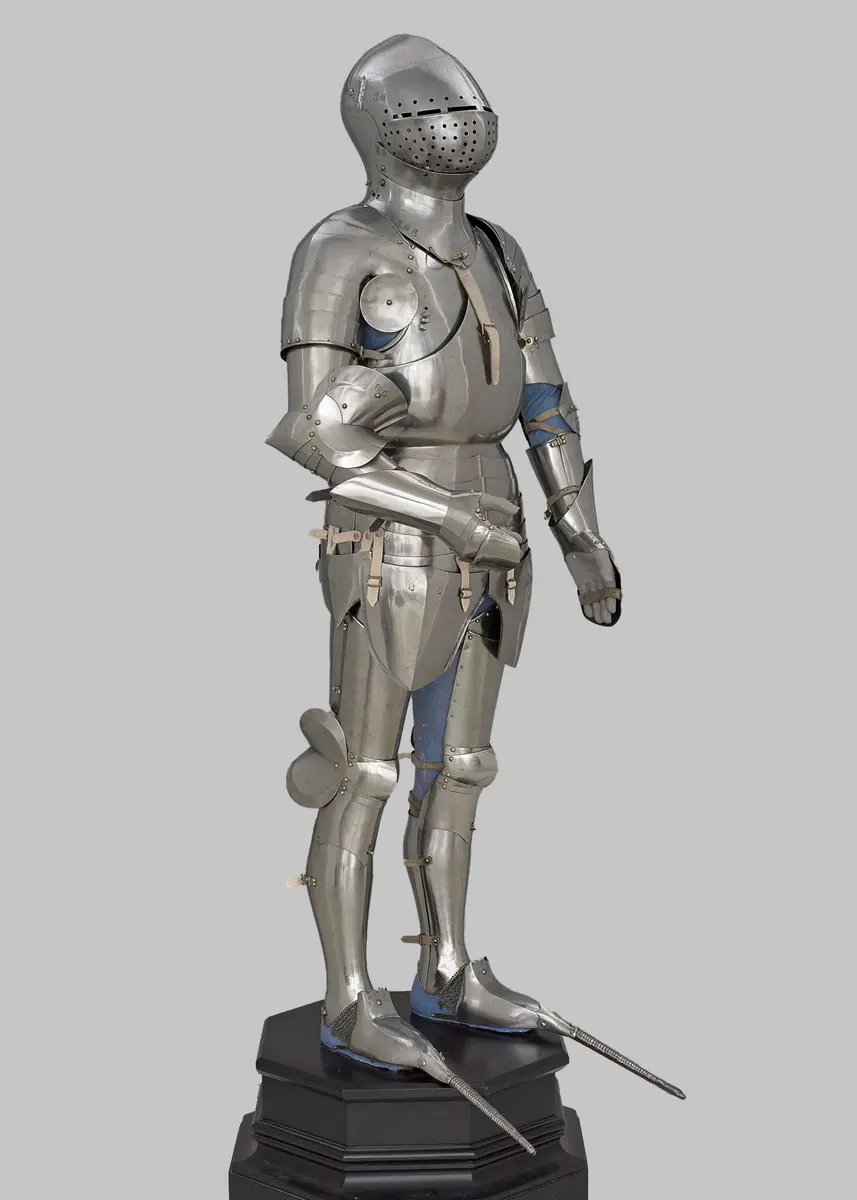
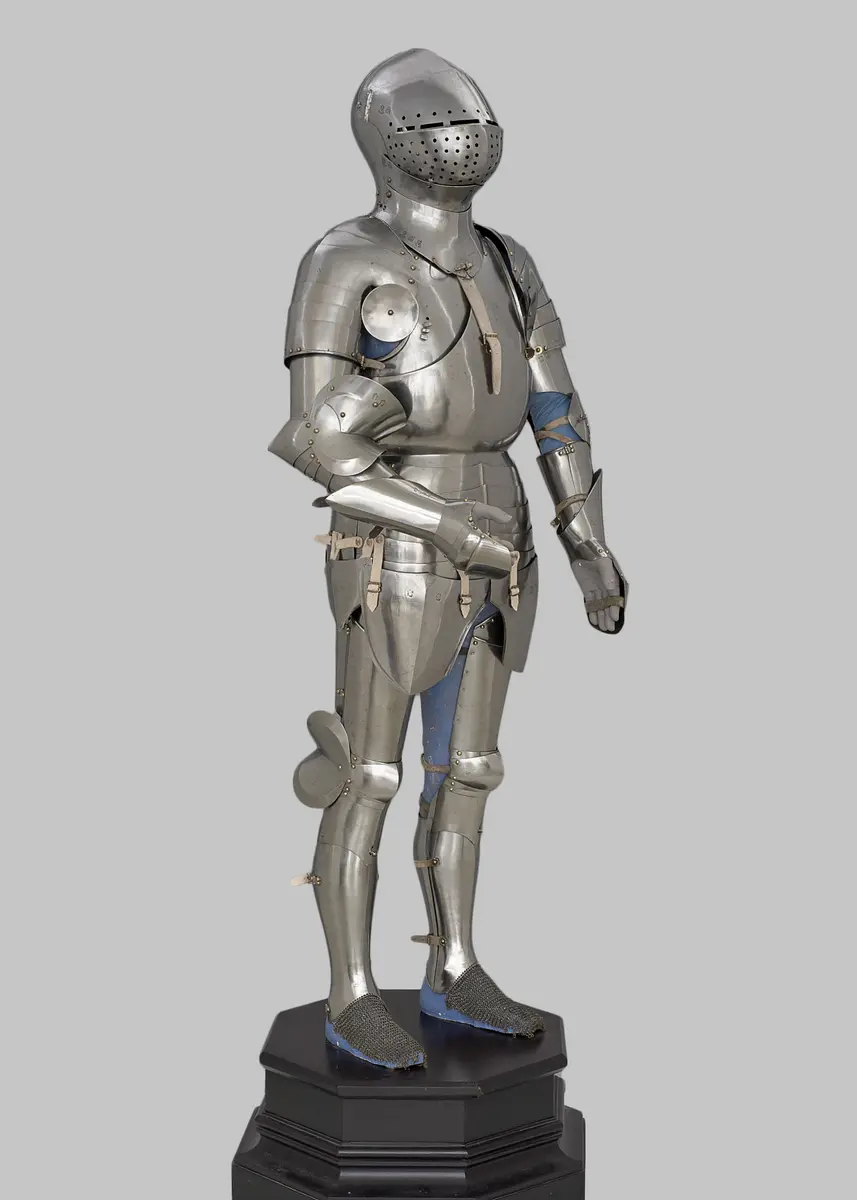
This armour is eloquent of the skill of Milanese fifteenth-century armourers. Commissioned around 1450 by Frederick I, Elector of the Palatine, it was produced by Tomaso Missaglia in collaboration with several other masters. In addition to Tommaso’s workshop mark and master’s mark, the armour was stamped with the marks of three other master-craftsmen – Antonio Missaglia, Innocenzo da Faerno, and Antonio Seroni. Such a division of labour was typical of Milan, then one of the leading centres of armour production in Europe. As armourers specialized in different parts of the harness – helmets, gauntlets, greaves, etc. – it was more efficient for them to collaborate. The homogenous appearance of this armour bears witness to the professionalism of the collaborating master-craftsmen.
Stylistically, we can date this armour to the mid-fifteenth century. Frederick presumably commissioned it for his accession in 1449. The marks of blows on the helmet show that he wore it in battle. However, some of the details of this harness do not conform to what one would expect of typical coeval Italian armour. For instance, the helmet is a grand basinet, a voluminous helmet with circular visor then popular in France but not in Italy. The shoulders are symmetrical and have besagews to protect the armpits. In ‘regular’ Italian armour, the right shoulder is smaller than the left, affording the wearer’s right arm (which wields the sword) additional mobility.
The armour includes stirrups that end in long tapered points, imitating the then fashionable poulaines popular mainly north of the Alps. This means the harness is export armour alla francese (in the French style), produced by Milanese armourers according to the requirements and tastes of their foreign client. They also produced armour in the German style (alla tedesca).
Owner:
Kurfürst Friedrich I. Sohn des Ludwig III. von der Pfalz (1425 - 1476) DNB
Artist:
Tomaso & Antonio Negroni da Ello, gen. Missaglia , (Plattner) (1430 - 1452 tätig in Mailand)
Time:
around 1450. Gauntlets: around 1475/1485.
Object Name
Field Armour
Culture
Mailand
Material/technology:
Iron, forged, chased. Rivet caps, buckles: brass. Leather (partly modern). Textile (preserved in fragments): velvet. Sabatons: mail: iron wire.
Dimensions:
H (inkl. Eisenplatte) 193cm x B 90 cm x T 81 cm
Gesamtgewicht exkl. Figurine, exkl. Eisenplatte: 31,04 kg
Signed
keine
Inscribed
keine
Stamp / markings
Y unter Rufhorn (Pier Inocenzo Faerno?)
AN unter Rufhorn (Antonio Missaglia)
M unter Sparrenkreuz (Tomaso Missaglia)
MY unter Krone (Tomaso Missaglia)
AN unter Sparrenkreuz (Antonio Seroni)
SE unter Krone (Antonio Seroni)
- Helm, rechts vorne: M unter Sparrenkreuz; MY unter Krone; M unter Sparrenkreuz; links hinten: M unter Sparrenkreuz; MY unter Krone; rechts hinten: MY unter Krone; M unter Sparrenkreuz; rechts am Visier: MY unter Krone; M unter Sparrenkreuz; rechts oben auf Kinnstück (unter Visier): MY unter Krone; rechts auf oberem Halsstück: M unter Sparrenkreuz; MY unter Krone
- Brust, oben seitlich je AN unter Rufhorn; vorne oben: Y unter Rufhorn
- Rücken, oben mittig: AN unter Rufhorn; Y unter Rufhorn; AN unter Rufhorn
- untere Brust, rechte Seite: AN unter Rufhorn; Y unter Rufhorn; AN unter Rufhorn
- oberste vier Bauchreifen, je rechts: 2x AN unter Rufhorn
- unterster Baureifen, vorne mittig: 2x AN unter Rufhorn
- Beintaschen vorne: je 2x AN unter Rufhorn
- unter
Copyright
Kunsthistorisches Museum, Hofjagd- und Rüstkammer
Invs.
Hofjagd- und Rüstkammer, A 2